For the last few days, my lab partner and I have been carrying out the percent acetic acid and vinegar lab, where we titrate acids in order to ultimately find the percent of acetic acid in commercial vinegar. First, we mixed about .5 grams of hydrogen phthalate into water to dilute it. Then, we added an indicator and titrated it with sodium hydroxide until the solution turned pink. When the solution turned pink, we knew that all of the KHP had been reacted with since the NaOH will react with the acid before the indicator. Next, we titrated diluted vinegar with the NaOH until it turned pink too (from the indicator). Since we recorded the amount of solutions used, we can calculate the molarity of the NaOH and find the molarity of the vinegar used. This information will eventually lead us into finding the vinegar's % of acetic acid in it. Here are some pictures from the lab:
Showing posts with label Acids and Bases. Show all posts
Tuesday, February 9, 2016
Saturday, February 6, 2016
Last Lesson
The last lesson that we learned about in the Acids and Bases unit involved stoichoimetry. Most questions asked to find the volume, pH, or concentration of a solution and gave about three pieces of information. For a couple of them, we had to find the limiting reagent. Here is a link to practice these types of question:
Chemteam
We also briefly discussed pH titration curves. Here is a picture comparing the titration curves of a strong acid and base:
Chemteam
We also briefly discussed pH titration curves. Here is a picture comparing the titration curves of a strong acid and base:
| http://chemistry.tutorvista.com/inorganic-chemistry/calculating-molarity.html |
Wednesday, February 3, 2016
ICE Problems
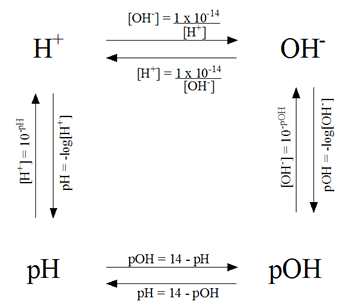
To complete all of the questions from this lesson, we used the flow chart below.
In the chart, the OH- is the hydroxide ions and the H+ is the hydronium ions in a solution. By knowing one of the components on the chart, you can solve the pH, pOH, or the ions of the acids and bases in that particular solution.
An example of a problem that would utilize this chart looks like this. The question regularly involves finding the equilibrium:
In this problem, the I stands for INITIAL, which is the original information you are given. The C stand for CHANGE, which is +x, -x, -x most of the time across. Lastly the E is for EQUILIBRIUM. Once you place all of the components in the chart, you add them down. Next, you take those components and put them in the expression on the right, placing the products over the reactants in the solution (not including water) and equal that to the constant. Then, you distrubute the the costant to the fraction to come up with a quadratic formula. Next, with the formula, you place the parts of the formula to form a quadratic equation to find x. After you solve for x, you have the ion concentrations of either the acid or base you were looking for. Finally, if you wanted to find the pH or the pOH of the solution, you place the concentration in the antilog.
Here is a link to practice these types of questions and further explanations:
Explanation
Practice
| http://www.sciencegeek.net/Chemistry/taters/Unit8pH.htm |
An example of a problem that would utilize this chart looks like this. The question regularly involves finding the equilibrium:
| http://pinl.net/vs/ice-tables-for-equilibrium.xhtml |
In this problem, the I stands for INITIAL, which is the original information you are given. The C stand for CHANGE, which is +x, -x, -x most of the time across. Lastly the E is for EQUILIBRIUM. Once you place all of the components in the chart, you add them down. Next, you take those components and put them in the expression on the right, placing the products over the reactants in the solution (not including water) and equal that to the constant. Then, you distrubute the the costant to the fraction to come up with a quadratic formula. Next, with the formula, you place the parts of the formula to form a quadratic equation to find x. After you solve for x, you have the ion concentrations of either the acid or base you were looking for. Finally, if you wanted to find the pH or the pOH of the solution, you place the concentration in the antilog.
Here is a link to practice these types of questions and further explanations:
Explanation
Practice
Monday, February 1, 2016
The Strength of Acids and Bases
On Thursday last week, we learned how to tell if an acid and base reaction forms an acidic, basic, or neutral salt. In addition, we discovered how tell if a solution is acidic,basic, or neutral.
First, we discussed salts. Below is a chart that shows how to know if the salt formed is acidic, basic, or neutral. As long as you know if the acid and base mixed in the reaction is strong or weak, you can determine the property of the salt.
Next, we learned about the concentrations of hydroxide and hydronium ions in solutions. To find the concentrations, we manipulate the formula below to solve for the component that we want.
You are usually given one of the concentrations and know that kw= 1.0 x 10^-14. So with those two pieces of information, you can find the solution's other concentration.
Here are a couple links that you can practice with and quiz yourself on with answers:
Predicting Salt pH
Calculating H-OH Ion Concentrations
First, we discussed salts. Below is a chart that shows how to know if the salt formed is acidic, basic, or neutral. As long as you know if the acid and base mixed in the reaction is strong or weak, you can determine the property of the salt.
| http://slideplayer.com/slide/2406970/ |
| http://study.com/academy/lesson/the-ph-scale-calculating-the-ph-or-poh-of-a-solution.html |
You are usually given one of the concentrations and know that kw= 1.0 x 10^-14. So with those two pieces of information, you can find the solution's other concentration.
Here are a couple links that you can practice with and quiz yourself on with answers:
Predicting Salt pH
Calculating H-OH Ion Concentrations
Wednesday, January 27, 2016
1st lesson
Today in class, we had our first lesson on our new unit: Acids and Bases. We first learned about the physical properties of acids and bases:
In addition to the picture above, acids feel sticky to the touch, like syrup.
Next, we discussed Arrhenius acids and bases. Arrhenius acids are acids that produce hydrogen ions in a solution. Arrhenius bases are bases that produce hydroxide ions in a solution. So, when put in a solution, the compound that they are a part of breaks apart and either increases the hydrogen or hydroxide concentration in the solution, depending on what is dissolved.
According to the pH scale, the lower the pH, the higher the hydrogen ion concentration in the solution. On the other hand, the higher the pH, the higher the hydroxide ion concentration.
We also learned about Bronsted- Lowery acids and bases. According to this definition, acids donate a proton and bases accept a proton. In B.L. definitions, we also have conjugate acids and bases. Acids produce conjugate bases and bases produce conjugate acids. You can see this in the picture below:

Here are a couple links to practice the new concepts we learned:
acid base quiz
acid and base quiz
| http://chemwiki.ucdavis.edu/Textbook_Maps/General_Chemistry_Textbook_Maps/Map%3A_Chemistry%3A_The_Central_ Science_(Brown_et_al.)/04._Reactions_in_Aqueous_Solution/4.3%3A_Acid-Base_Reactions |
In addition to the picture above, acids feel sticky to the touch, like syrup.
Next, we discussed Arrhenius acids and bases. Arrhenius acids are acids that produce hydrogen ions in a solution. Arrhenius bases are bases that produce hydroxide ions in a solution. So, when put in a solution, the compound that they are a part of breaks apart and either increases the hydrogen or hydroxide concentration in the solution, depending on what is dissolved.
According to the pH scale, the lower the pH, the higher the hydrogen ion concentration in the solution. On the other hand, the higher the pH, the higher the hydroxide ion concentration.
We also learned about Bronsted- Lowery acids and bases. According to this definition, acids donate a proton and bases accept a proton. In B.L. definitions, we also have conjugate acids and bases. Acids produce conjugate bases and bases produce conjugate acids. You can see this in the picture below:
Here are a couple links to practice the new concepts we learned:
acid base quiz
acid and base quiz
Monday, January 25, 2016
Vitamin C Lab Day 1
Today in class, my lab partner and I did part of the vitamin c lab. First, while waiting for the vitamin c lab standard solution to be made by another lab group, we filled up our different pipets with apple juice, pear juice, V8 juice, white grape juice, starch, and iodine. We made sure to keep the iodine dark and covered in tin foil to prevent it from decomposing. While performing the lab, on one round, we took 20 drops of the vitamin c standard solution and added three drops of starch to that. Then, we added drops of iodine, making sure to count all the drops, until the solution changed from clear to a dark blue. The dark blue color indicated the end of the reaction between the vitamin c and the iodine. We repeated this a few more times, switching out the vitamin c solution with the different juices. Here are some pictures from the lab:
Here is also a helpful website about our new unit:
Acid Base Link
Here is also a helpful website about our new unit:
Acid Base Link
Subscribe to:
Posts (Atom)