Showing posts with label Atomic Structure/Periodic Trends. Show all posts

Tuesday, March 1, 2016

Periodic Trends

In our last lesson of the unit, we learned about periodic trends. There are 4 trends that mainly focus on the S and P blocks on the periodic table. First, we learned about atomic size. As you move across a period from left to right, atomic size decreases because there is an increase in protons. Since the protons increasingly attract the electrons, the electrons pull toward the protons more and more, making the size smaller as you go to the right. Here is a chart that displays this trend:

https://www.boundless.com/chemistry/textbooks/boundless-chemistry-textbook/nonmetallic-elements-21/properties-of-nonmetals-147/atomic-size-569-7507/
Next, we discussed ionization energy. Ionization energy is the energy needed to remove an electron from a gaseous state. As you move up and to the right of the periodic table, the ionization energy increases. Here is a chart that displays this concept;
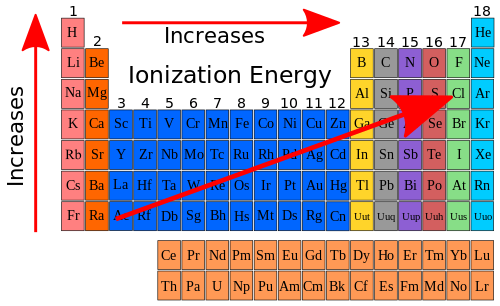
https://en.wikibooks.org/wiki/High_School_Chemistry/Ionization_Energy

Then, we learned about trends in electron affinity, which is how easy it is to add another electron to an atom. Electron affinity also increases as you move up and to the right of the periodic table. Here is a chart the exemplifies the trend:

https://en.wikibooks.org/wiki/High_School_Chemistry/Electron_Affinity

Lastly, we discussed trends in electronegativity, which is the tendency of an atom to draw electrons toward itself when chemically combined with another element. Elements with larger electronegativity tend to pull electrons to themselves when bonded to other elements. It increases as you go up and to the right of the periodic table too. Here is a chart that displays this trend:

http://chemteacher.chemeddl.org/services/chemteacher/index.php?option=com_content&view=article&id=91

Here are a couple links that further explain some of these trends:

Monday, February 29, 2016

Quantum Numbers

Last week, our chemistry class learned about quantum numbers. In the lecture, we were told that every atom is assigned a set of four quantum numbers. The first number is the principle quantum number. This number corresponds to the atom's principle energy level. The second number is the angular momentum quantum number. This digit represents the atom's final sublevel. The numbers are s=0,p=1,d=2,and f=3. Next, the third quantum number is the magnetic quantum number, which is determined on the last valence electron's placing on its orbital. This number can range from -3 to +3 when in a f sublevel. Finally, the last quantum number is the spin quantum number, which can either be -1/2 or +1/2. This is determined by knowing which direction the last valence electron in an atom faces (up or down on a chart). Below are examples:

http://chemwiki.ucdavis.edu/Core/Physical_Chemistry/Quantum_Mechanics/10%3A_Multi-electron_Atoms/Quantum_Numbers

Here are a couple links to help:

Wednesday, February 24, 2016

Tuesday, February 23, 2016

Lab

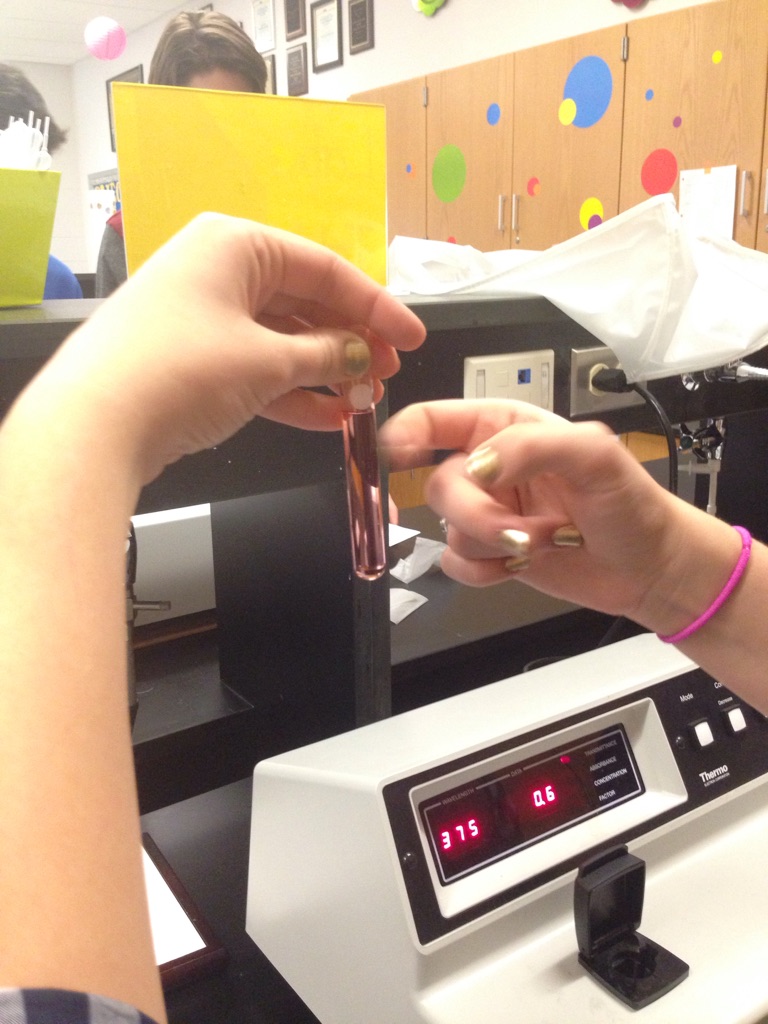
Today in class, my partner and I conducted a lab using a spectrophotometer. To zero out the the machine, we used water in a cuvette and adjusted knobs to zero and one hundred percent transmittance. Then, we placed one of our solutions, Cr(NO3)3, also in a cuvette, in the machine to measure its percent transmittance and absorbance. Next, we placed the CoCl2 in a cuvette in the machine and measured its transmittance and absorbance. We repeated this entire process multiple times, changing the wavelengths each time. Here are some pictures from the lab below.


Thursday, February 18, 2016

Flame Test

Today in class, we conducted the flame test. After passing a pre-lab that reviewed the lesson from yesterday, my partner and I went to the lab to start our experiment. We had various solutions and crystals, all of different metals. We took a wooden stick that soaked in the solutions and put it into a flame to see what color is produced. We also put crystals in the flame to see what color they made. With the color, we will be able to look at the light spectrum to find the metals wavelength. With this information, we will eventually be able to calculate the energy of one mole of photons for each various metal. Here are some pictures from the lab below:


Wednesday, February 17, 2016

New Unit

Today in class we learned the first lesson of our new unit, electronic structure. We discussed the wave nature of light and how every object has a wave nature. In addition, all waves have a characteristic wave length. Below is a picture of the different parts of a wavelength:

http://dev.physicslab.org/document.aspx?doctype=3&filename=wavessound_introductionwaves.xml

The longer the wavelength, the shorter the amplitude and the lower the energy. 

Next, we learned the formula for velocity. Here it is below, showing what each symbol means and the unit that corresponds with each:


http://accessiblemediacenter.techadapt.com/samples/CAST_Exemplars/Exemplar6/content/bodymatter-level2-121.htm

C, which is a constant (speed of light= 3.0x10^3) often replaces v in the formula. With at least two parts of the formula, we can solve for any of the pieces of the formula.

Here are a couple links that are helpful:
basic chemistry for mad scientist